
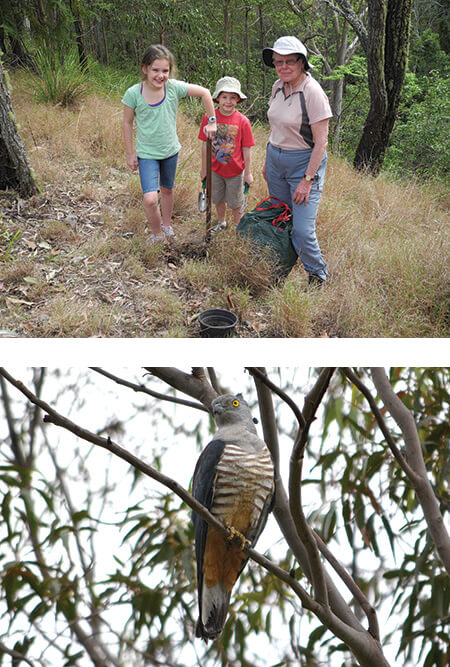
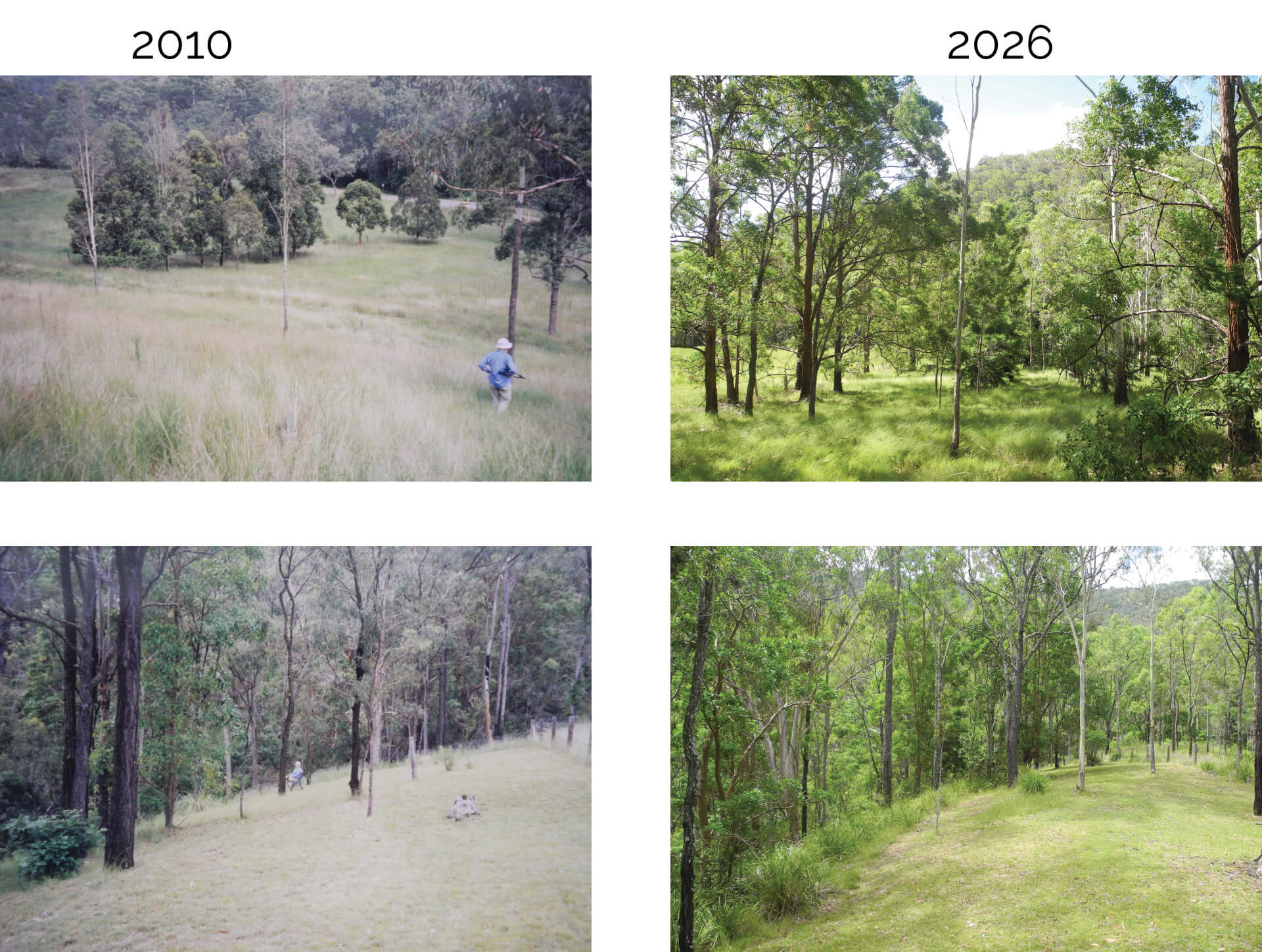
Barb acquired 5 1/2 hectares at Christmas Creek in 2002. The property had been a gravel quarry and consisted of two bare, sloping, weedy paddocks and three dry creek beds at the time of purchase.
Weeds were a problem. Most obvious at that stage was lantana, and we set about getting rid of it by cutting stems and applying herbicide. During that period of the Millennium Drought, eradication appeared easy. However, the nature of the terrain necessitated the use of previously learned bushwalking and rock-climbing techniques, notably abseiling. The latter presented some difficulty, because one was necessarily encumbered by shears, poison etc.. I recall abseiling off the end of the rope whilst engrossed in locating the base of a particularly tangled lantana.
Another principle which guided our efforts was that we should try to retain water on the property. This was accomplished by riparian planting, mainly of Hoop Pines, callistemons, melaleucas and lomandras. We also placed obstacles such as logs and boulders in creek beds.
At this late stage of 2025, drought is not a problem, though doubtless it will be again. Our experience is that the worst weeds are: 1) Lantana 2) Glycine 3) Leucaena and 4) Chinese Elm.
The exercise has given rise to some questions; notably, “What is a weed?” A weed is a plant in the wrong place, but our rule of thumb is that if a plant is taking over from native plants, it deserves eradication. Our observation after all this time is that one should seek to tip the balance in favour of plants which we assume existed here before European colonisation.
It’s easy to be overwhelmed by the magnitude of the task. In general, the phrase “Land for Wildlife” encapsulates the principle that if the creatures who lived there before our arrival are happy, something must be going right. Although one must be vigilant and never relax in the battle against encroachment by species of plant which don’t belong, over time restoration becomes easier.
A distillation of our learning over the years would be:
- Don’t plant exotics.
- Keep indigenous animals, birds and insects happy.
- Retain water.
- Get rid of the invasive plants.
Our experience has left us in awe of the intricacy of systems represented in the bush. Although our knowledge is extremely limited, it is gratifying to try to improve things.
Article and photos by
Barb McGuire and Lionel Hartley
Land for Wildlife members
Christmas Creek, Scenic Rim