
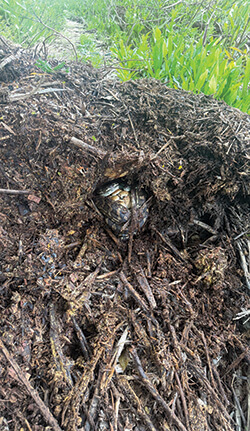
Land for Wildlife member, Martin, wasn’t too surprised when he sighted a quite swollen Coastal Carpet Python (Morelia spilota subspecies mcdowelli) around his house at Anstead and assumed this was the result of its last meal. What he didn’t expect to find a week later in his compost mound was a female python curled around a clutch of eggs, nor a second female at the opposite end of the same mound, also curled around her eggs. Needless to say, Martin carefully re-covered both pythons and gave up on the idea of mulch spreading for the next couple of months.
Reptiles, in general, aren’t known for caring for their young, but some python species are very attentive mothers. Carpet Pythons lay a clutch of somewhere between 10-50 leathery eggs in late spring to early summer and then stay with them until they hatch around 8 weeks later. During this time, they protect their eggs and also help to incubate them by wrapping their body around them. This isn’t just passive. If needed, they’ll bask in the sun to raise their body temperature and use this stored thermal energy to aid egg incubation. On top of this, they will also shiver to produce body heat to keep their eggs warm. Despite these various strategies the overall hatching time is still largely influenced by the ambient temperature. In the cool environment of Mt Glorious, a Coastal Carpet Python was recorded incubating her eggs for 111 days before they hatched.
This attentiveness comes at a cost, as females don’t feed during this time and can lose up to a quarter of their body weight. Upon hatching all parental responsibility ceases and the around 30cm long hatchlings are on their own.
Mating for Coastal Carpet Pythons occurs from the end of winter into spring. This rarely witnessed event is initiated when a male wraps around a receptive female. In contrast, what is more commonly seen and mistaken for mating, is territorial disputes between males as they assert dominance for the right to mate. These are quite energetic encounters, unlike mating, as the rivals constantly twist and coil around each other and push each other to the ground. Eventually one will give up, leaving the winner the right to mate with females in its territory.
Adult Coastal Carpet Pythons can reach a very impressive 4 metres (they are the largest subspecies of Carpet Python), but the norm is closer to the 2 to 2.5 metre mark with females being a bit smaller than males. At this size they are at the top of the food chain with very few natural predators. Smaller pythons however are preyed upon by various animals. They also face human threats including car strike, habitat loss and the poisonous Cane Toad. That said, the Coastal Carpet Python has largely adapted well to human habitat change and they are frequently found even in highly urbanised areas. Unfortunately, there is another potential looming threat – Boid Inclusion Body Disease (BIBD) caused by a Reptarenavirus. As at writing, this fatal disease has only been found in captive pythons in Australia.
The common name, Carpet Python, refers to their striking carpet-like patterning. The patterning of Coastal Carpet Pythons, like their very broad range – along the coastal fringe from Cape York Peninsula to northern NSW and the equally broad habitats they occupy, is also highly variable. Dorsal (topside) colouration varies from brown to grey to olive which is broken up by mottling, blotches and lines. Colour morphs also naturally occur. Some interbreeding between the Diamond Python (subspecies spilota) also happens where their ranges overlap leading to more, but fairly localised, patterning variation. Depending on which taxonomic database you use, there are 6-8 subspecies of Carpet Pythons.
These large, slow-moving snakes are active during the day and night and are adept climbers. They typically eat warm blooded animals which they sense primarily using heat sensitive pits on their snout and lower jaw. They’ll occasionally take reptiles and amphibians (these are a far more important component of a young python’s diet) using that other snake associated sensory organ – their forked tongue and Jacobson’s organ to hunt these cold-blooded animals.
Carpet Pythons are quite reclusive, but like most snakes, can, and will bite if they feel threatened. Having a mouthful of around 100 sharp recurved teeth, their bite can be painful, but they are non-venomous. If you come across a Carpet Python, show respect and give it a bit of room, that is all that’s needed for a memorable wildlife encounter.
Photo at top: This Coastal Carpet Python was quite content wrapped around the washing line on Donna and Trevor Greaves’ Land for Wildlife property at Coominya earlier this year. It was a stunning yellow colour.
Tony Mlynarik
Land for Wildlife Officer
Brisbane City Council
References and Further Reading
Atlas of Living Australia – bie.ala.org.au
Queensland Museum – museum.qld.gov.au
Snake Catchers Brisbane – snakecatchers.com.au
Wildlife Health Australia – wildlifehealthaustralia.com.au
Wildlife Queensland – wildlifeqld.com.au