
Summer is once again upon us and with it comes the humidity and the inevitable storms. We’ve already welcomed those obvious, raucous, northern migratory birds, the Eastern Koels and Channel-billed Cuckoos with their booming calls, and in the case of the Channel-billed Cuckoo their unmistakable look and silhouette. There is however another northern migratory bird that has also slipped into our midst that is largely unseen and unheard, except by keener wildlife observers.
Mid to late September is when the Sahul Cicadabird starts to reappear along the east Australian coastal fringe. These birds have spent the cooler months in far north Queensland and New Guinea and have flown south to breed (small and inconsistent numbers of birds have been reported overwintering in the Brisbane region).
The name Sahul Cicadabird is still relatively new and is still being recognised in ornithological circles. Recent DNA analysis of what was the ‘Common Cicadabird’ has seen this broken into multiple new species with many subspecies. The Sahul Cicadabird retains the ‘old’ species name (Edolisoma tenuirostre) and is made up of six subspecies, two of which are found in Australia. The endemic, non-migratory one is found in northern Australia. The other one, subspecies tenuirostre, migrates north/south from far north Queensland and Papua New Guinea and temporarily calls SEQ ‘home’.
The whole Cicadabird genus (Edolisoma) is an incredibly complex array of species and subspecies that’s a result of successive radiation into new territory followed by isolation and remixing events during the Pleistocene. For this reason, the cicadabird has been described as a ‘great speciator’.
Sahul Cicadabirds are strongly sexually dimorphic in their plumage. Males are quite striking even though they are basically just grey and black. Females on the other hand, have a light-brown chest with thin darker-brown barring from the upper chest to the lower belly. Their eye stripe is dark brown with a lighter brown eyebrow. Juveniles are similarly coloured to females but have more pronounced barring.
Come nesting time a shallow cup shaped nest is built high up in a tree. It is commonly constructed of bark, dry grass, small twigs and lichen, all of which is held together by spider web. The exterior is then adorned with lichen and moss. Into this is laid a single egg. Both parents feed the growing chick, although the female does the majority of feeding. By April/May juvenile birds will be ready to join their parents for the long migratory journey north.
There are various reasons why Sahul Cicadabirds aren’t regularly reported, all of which relate to their lifestyle. They tend to be solitary birds, getting around singularly, in pairs or small family groups. On top of this they prefer fairly closed mature forest, or old regrowth forest where they spend the majority of their time mainly high in the tops of trees searching for food. Their diet consists mainly of large insects including cicadas. They also eat fruit and seeds.
Although they do eat cicadas, the ‘cicada’ part of their common name is in reference to their primary call, rather than any culinary preference. This is a short, repetitive, almost insect-like ‘buzz’ (which is another reason they go undetected) that will be repeated 8-20 or so times. As for the name Sahul this is a reference to its geographical distribution – the Sahul Cicadabird is found in Australia, New Guinea and Islands off New Guinea. Sahul is the name of the Pleistocene connected landmass of Australia and New Guinea that periodically formed during glacial extremes during this epoch.
Over the next couple of months keep an ear and an eye out for the Sahul Cicadabird which is a great example of ongoing evolutionary processes and the interconnectedness of the natural world.
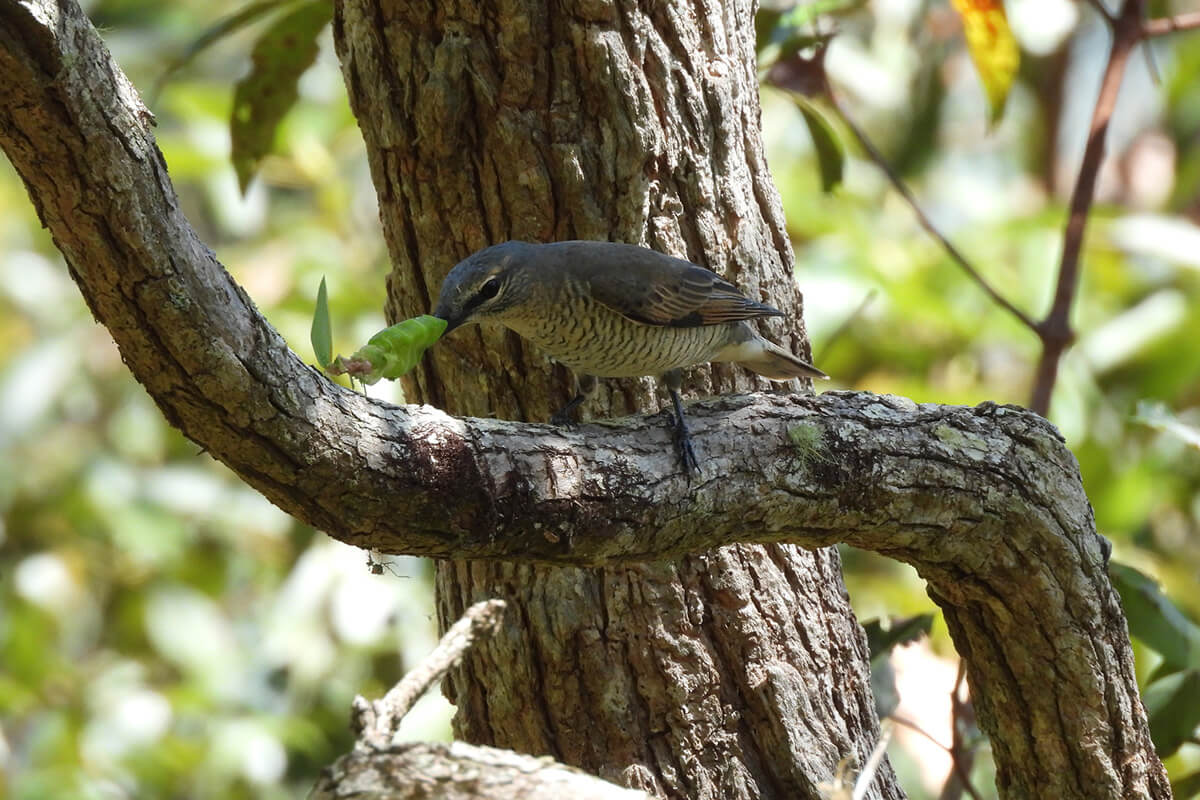
Photo by Mark Clarke (hatwise), iNaturalist
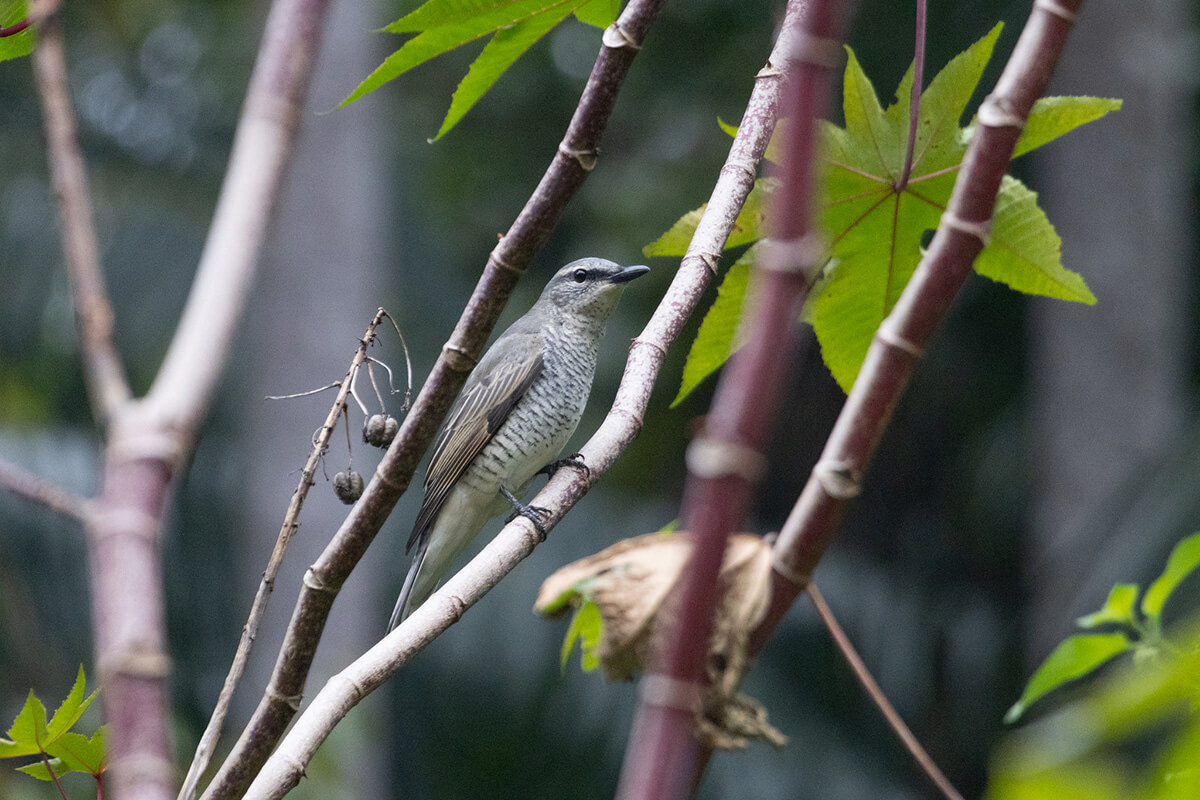
Photo by Chris Burwell (christopherburwell), iNaturalist
Header image: Male Cicadabird, photo by Todd Burrows.
Article by Tony Mlynarik
Land for Wildlife Officer
Brisbane City Council
References and Further Reading
Pendersen M et al (2018) Phylogeography of a ‘great speciator’ (Aves: Edolisoma tenuirostre) reveals complex dispersal and diversification dynamics across the Indo-Pacific. Journal of Biogeography.
www.worldbirdnames.org
www.birdforum.net
www.ebird.org