
The Powerful Owl Project is a national program that has been running for 11 years across south-east Queensland (SEQ) and greater Sydney. The project has advanced our understanding of Powerful Owls and has enabled thousands of people to connect with this magnificent bird.
Despite their large size, Powerful Owls can easily go undetected. They roost during the day along creeklines sheltering in quiet, cool, shady areas where they can sleep. During the night, they set out to hunt.
The forest floor under their daytime roosts is often smelly and littered with droppings and remains of their prey. All owls eat their prey either whole or in chunks. The indigestible bits like bone, feathers and fur are regurgitated in gherkin-shaped lumps called owl pellets. Project volunteers have sorted through hundreds of Powerful Owl pellets to help determine what the owls are eating. In SEQ, their main prey are possums, gliders, flying foxes and some birds like Rainbow Lorikeets.
The Powerful Owl Project in SEQ has been successful because of committed volunteers like Nick, Lucy, Brett and Kev who collectively spend about 650 hours a year surveying owls. They have watched owl pairs successfully breed and raise chicks, and they have watched adult owls pass away and fledglings fail to leave the nest.
In 2025, volunteers monitored 18 active nest sites, which produced a total of 23 fledglings. Unfortunately, no nesting occurred at several well-known breeding sites in Brisbane and Toowoomba. This is possibly due to the high levels of visitation by photographers and dog walkers the previous year.
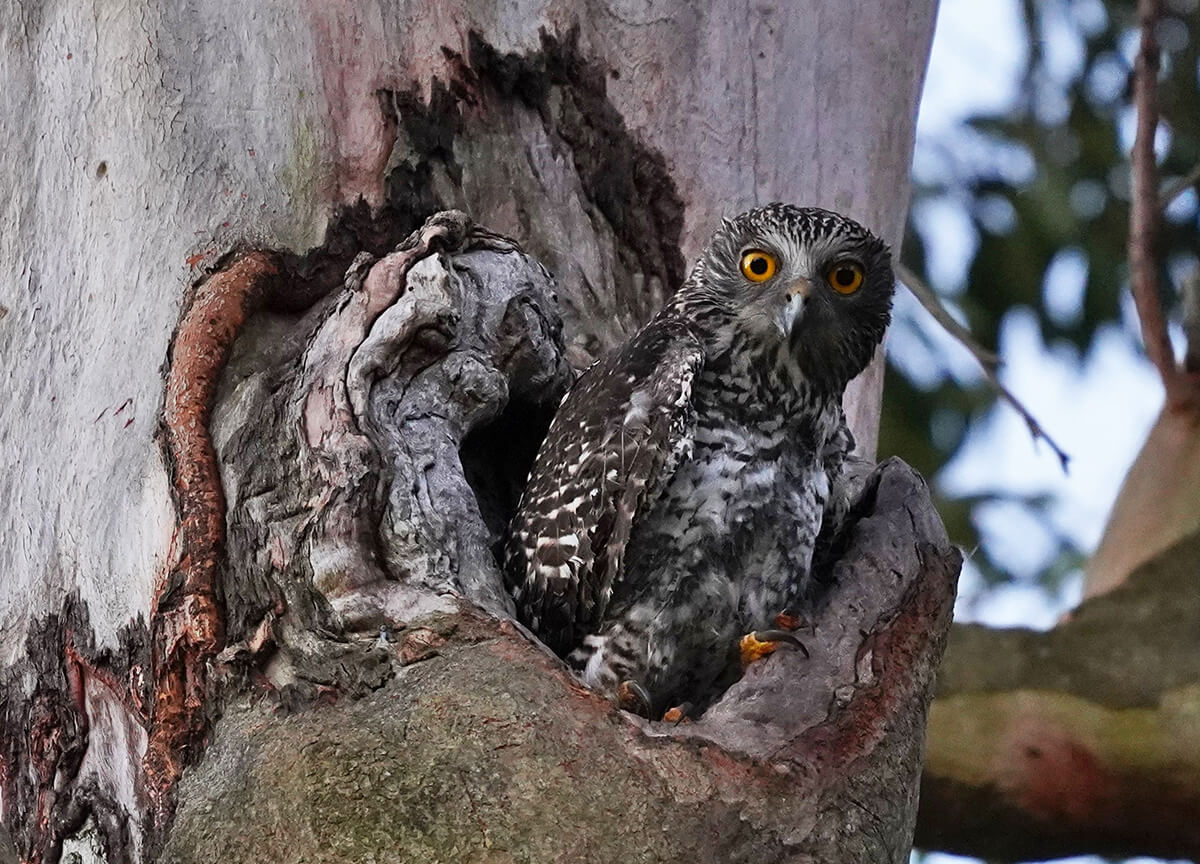
The limiting resource for Powerful Owls in SEQ is not food or daytime shelter sites, it is old-growth trees with large hollows. It is in these hollows that owls breed. We lost a couple of known owl breeding trees in Cyclone Alfred last year, which is why every old-growth tree with hollows, alive or dead, is priceless. There is positive news from the Greater Sydney region where a pair of Powerful Owl successfully bred in a nest box. Hopefully, nest boxes for Powerful Owls will be further deployed in habitats where natural hollows are low in number or absent.
An ongoing concern for Powerful Owls in Australia is the continued supply and use of certain rodenticides that kill owls and other birds of prey. The ‘bad’ rodenticides are called second-generation anticoagulant rodenticides (SGARs) and are readily available at supermarkets and hardware shops despite being banned in the USA, Canada and EU because of their harm to wildlife. Rats and mice that eat rodenticides are weakened and are easy prey for owls. Unfortunately, if an owl eats a poisoned rodent, it too can die from the poison. The Birdlife Australia website lists all ‘good’ and ‘bad’ rodenticides available in Australia. Please try not to buy or use SGARs.
Image top: Powerful Owl female emerging from a nest on dusk. Photo by Dr Nick Hamilton (Flickr @interestedbystandr)
We are always looking for more volunteers to join this project. All training will be provided.
To find out more or register to become a volunteer, visit the Powerful Owl Project page at birdlife.org.au or contact Andrew Dinwoodie at Birdlife Australia on powerfulowl-brisbane@birdlife.org.au
or 0455 876 237.