
I rarely go anywhere without my sketchbook and pen these days. Paying close attention to nature has become a cherished habit, and I feel impelled to capture fleeting thoughts and what I see in pen or watercolour.
As a young child I remember many outings to national parks and picnics with extended family. As I grew and was able to reach tractor pedals propped forward with piles of cushions, I spent time with my grandad out in the paddocks over many seasons checking soil moisture, the readiness of sunflower seeds for harvest, and digging with bare hands into sticky black soil for potatoes. I was my grandma’s shadow as we filled our aprons and shirts with sugar snap peas and dirt-covered carrots, and balanced on rickety wooden ladders to pick quince and pears. The shapes, colours, smells and textures of nature never ceased to grab my attention. Capturing nature with drawings or random scribbles in diaries has been an on-and-off love for many years.
Despite working in an office for most of my career, my interest in nature has only deepened. I joined Land for Wildlife South East Queensland more than six years ago and there began an exploration down endless rabbit holes which then inspired a re-learning about sketching and capturing my observations in a journal. In 2025, inspired by botanical artist, illustrator and nature journaller Lara Call Gastinger, I started a perpetual journal divided into 52 weeks. Each year, during each week, I draw something I observe. I decided I wanted to capture what was in my own backyard; plants, animals, insects, fungi, slime mould it’s all in there.
The whole process has resulted in me slowing down and using art as a tool for observation, for paying attention to the big and small, for building familiarity with the plants and animals we share our land with. Olivia, the Eastern Grey Kangaroo (Macropus giganteus), is a regular visitor and has had four joeys here. We have watched them emerge from the pouch and take their first shaky hops, do zoomies around the yard and then tumble back into her pouch with their spindly legs sticking out.
My drawings from early 2025 show an explosion of fungi following wet conditions, while the same period in 2026 was much drier, with fewer fungi but more woody species. During the same time, I drew the Grass Lilies (Murdannia graminea). Very typically they are a soft mauve, with little fluffy haired centres but with surprise I observed a rare white-flowered variation.
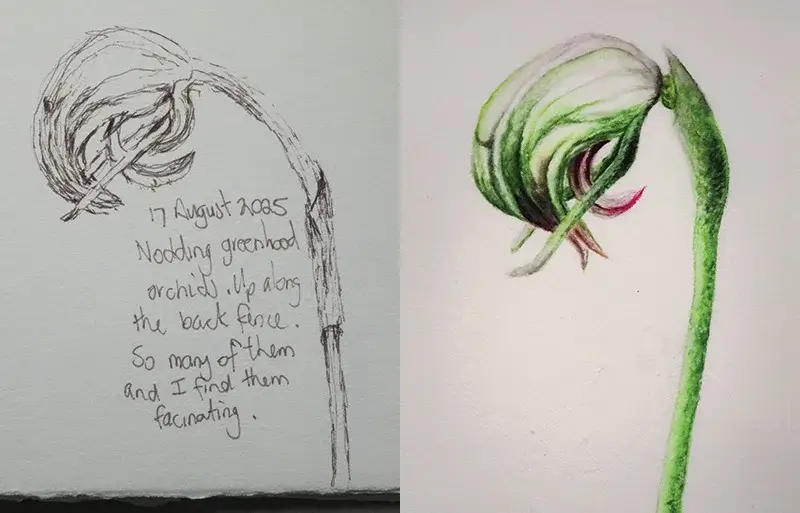
In mid-2025 I began a love affair with the Small Nodding Greenhood (Pterostylis hispidula) – a small insignificant orchid that “nods”.
If you didn’t get down on the ground, right into the grass and damp leaves you would miss the delicate transparency of the white and green hood known as the labellum ready to “lock” and close the entrance to trap the pollinator inside.
By mid-2026 I had drawn the orchid at least 50 times, taken countless photos and learned that it emits a wind-borne scent that mimics female fungus-gnat (family Mycetophilidae) pheromones to attract the male. The male gnat lands on the labellum which is triggered by the touch sensitive structures to close and trap the gnat. Inside the orchid, the gnat wanders looking for a way out. Eventually it finds a narrow opening and is released with fresh pollinia (a single mass of pollen) attached to its thorax to fly off to another Small Nodding Greenhood to repeat the process. The little patch of Small Nodding Greenhood is in a very shady patch and this year they have spread, so I guess the gnat is doing a good job.
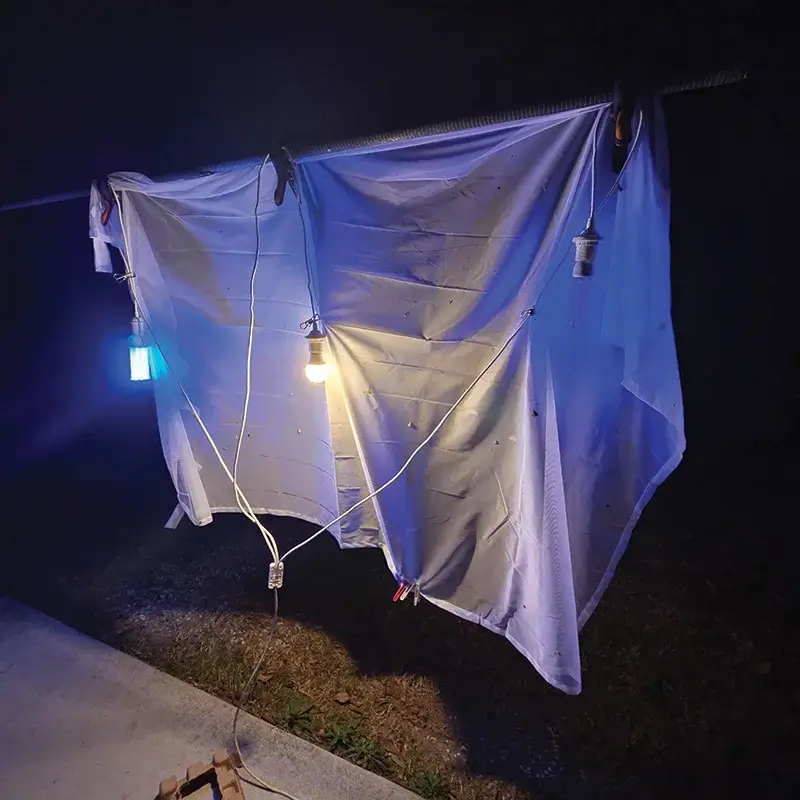
In early 2026 I attended an insect illustration workshop at Lake Eacham, Far North Queensland. It was here that I learnt new skills not only in illustrating but also in ways to attract insects for observation. The workshop taught me how to attract insects to one spot for observation by using a light sheet illuminated with different wavelengths of light.
Consequently, I started hanging up a light sheet most weeks. I’ve observed moths, beetles, katydids, flies and all sorts of other insects being attracted to the lights. I learned how to draw moths, their patterns, colours and textures are easy to overlook. I have become familiar with the regular visitors. Without fail each time I put up the light sheet something new arrives for me to draw. Now I’m on a quest to draw all the different moths that visit.
Being part of Land for Wildlife South East Queensland has inspired me to increase the diversity of plants and animals on my patch. Using art to draw the plants and animals in my backyard means that I spend a lot of time observing the land intimately, noting changes of the season and what’s happening earlier or later, what isn’t showing up, like the bees missing for the last few months or the current mystery of what is happening at night that we’re trying to solve with the help of a wildlife monitoring camera. This close collaboration between art and science has made me a more observant person, someone who cares more deeply about all of nature, from the nearly microscopic slime mould on a stick to the 1.8 metre tall male Eastern Grey Kangaroo (Macropus giganteus) hopping past the kitchen window in the early morning.
I hope my perpetual journal will become an archive of the incredible diversity on the place that I and thousands of organisms share. I encourage everyone to pick up a pen and a piece of paper and draw what they see. We can all make marks, whether as words, a loose sketch or a complete illustration, and use our curiosity and patience to build a deeper connection with the landscape.
Photo top: A nature journal can reveal the changing rhythms of a property, one observation at a time. Land for Wildlife SEQ member Keryn records what she sees each week through drawings and notes. In early March, fungi stole the show, with an abundance of fruiting bodies emerging across her property.
Article, illustrations and images by Keryn Klein
Land for Wildlife member and Logan City Council colleague, Logan
A couple of favourite articles and websites of Keryn’s
Lara Call Gastinger – Perpetual Journal
Pterostylis nutans: Nodding Greenhood | Atlas of Living Australia
John Muir Laws – Nature Journalling
Bethan Burton