
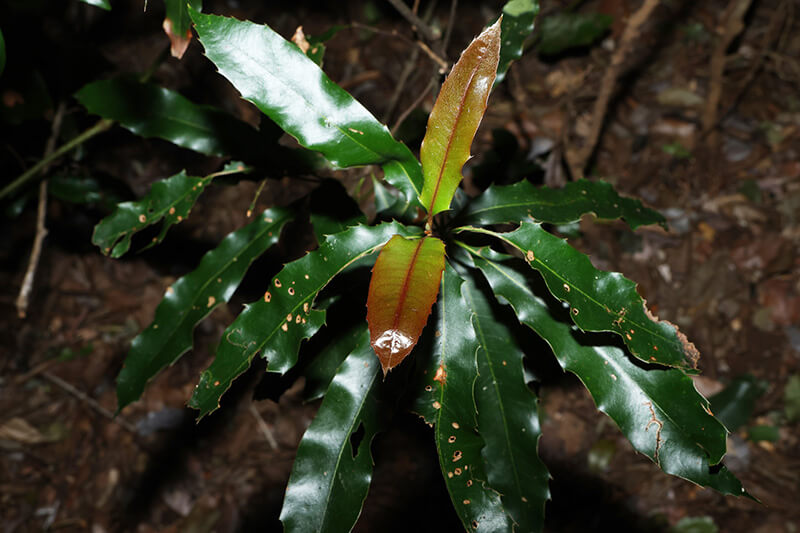
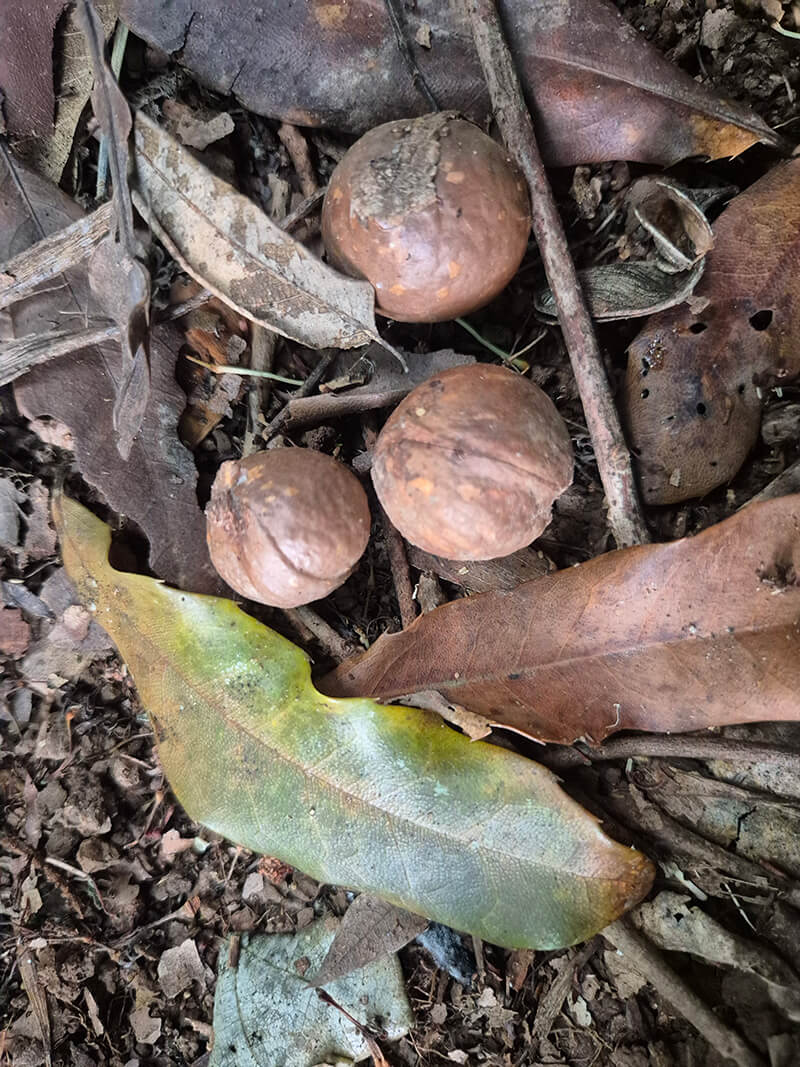
Photo by Greg Tasney (gregtasney), iNaturalist
As a child it was always a treat to see a bag of macadamias arrive in the house, knowing there would be lots of fun ahead for myself and my siblings – placing the nuts in a hole in the concrete, getting the biggest hammer we could find and cracking to our hearts content. Who doesn’t love eating macadamia nuts?! First Nations People from across SEQ have enjoyed and traded macadamia nuts for thousands of years.
Many people are unaware that there are four species of macadamia and all of them are native to Queensland.
Unfortunately, wild macadamia trees and their habitats have declined in Australia since European settlement. The three most common species of macadamia are Queensland Nut (Macadamia integrifolia), Rough-shelled Macadamia (Macadamia tetraphylla) and Gympie Nut (Macadamia ternifolia). These species are all listed as Vulnerable under Queensland and Commonwealth legislation. The fourth species, Bulberin Nut (Macadamia jansenii) is listed as Critically Endangered under the Queensland Nature Conservation Act 1992 and Endangered under the Commonwealth Environment Protection and Biodiversity Conservation Act 1999.
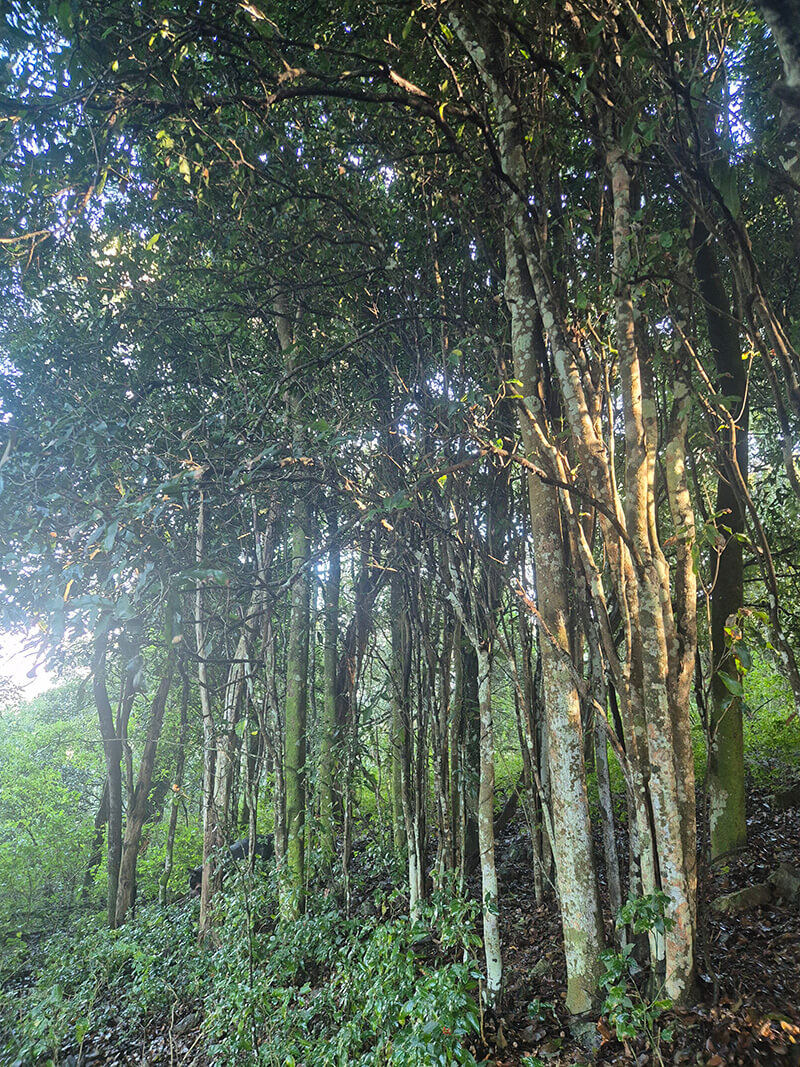
The Redlands has Macadamia integrifolia and probably hybrid Macadamia tetraphylla. More insights will be gained when genetic analysis from leaf samples is complete.
Wild macadamia populations face several threats, namely:
- Habitat Loss. Approximately 80-90% of macadamia habitat has been lost since European settlement.
- Weed Invasion. Weeds that form a dense groundcover can block macadamia germination, while invasive vines can smother and kill seedlings and mature macadamia trees. Weeds that seem to have the greatest negative impact on macadamia populations at Mount Cotton are Ochna, Coral Berry, Cat’s Claw Creeper and Madeira Vine.
- Livestock. Poor livestock management has resulted in damage and loss of macadamia populations.
- Loss of Connectivity. Loss of wild populations across the landscape and widespread planting of genetically similar orchard stock has the potential to cause genetic dilution.
- Fire. Macadamia trees may survive low intensity fires by resprouting but are likely to be killed by high intensity fires.
- Climate Change. It is predicted that climate change will have a negative impact on wild macadamia populations through increased heat and changes to rainfall patterns. These may lead to tree stress and increased pest infestation.
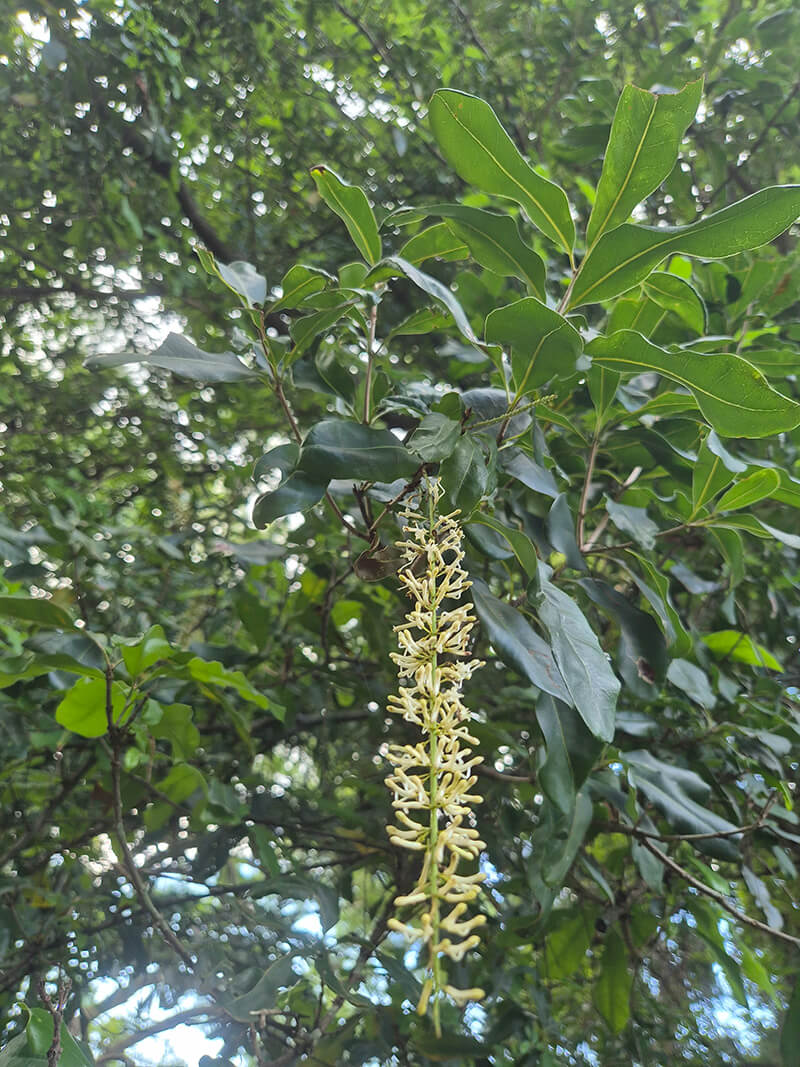
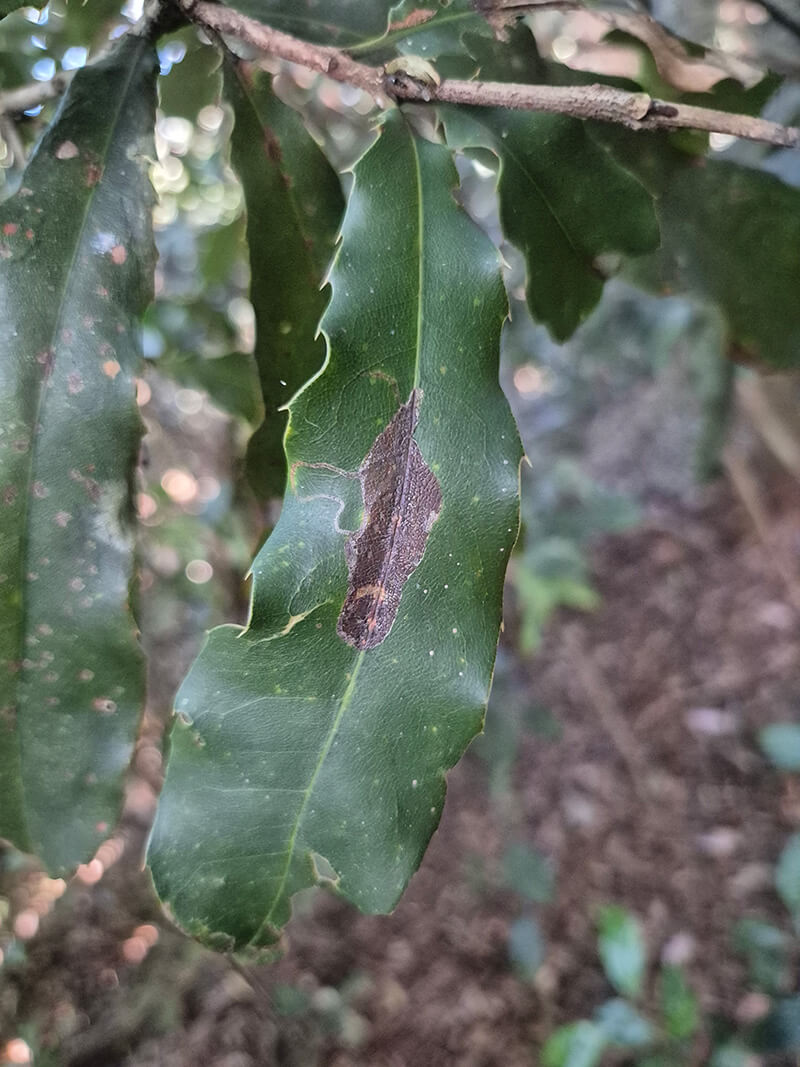
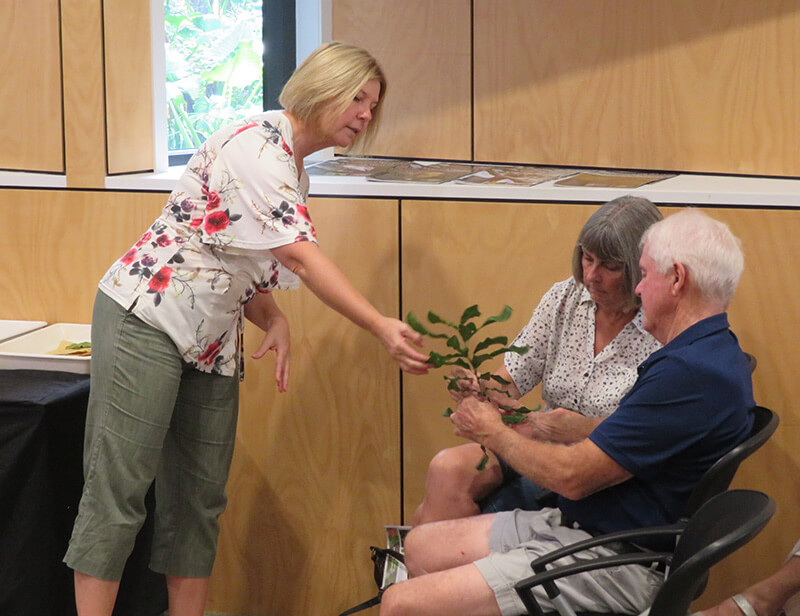
In 2015-16, Healthy Land & Water, Macadamia Conservation Trust and Redland City Council partnered together to survey known locations of wild macadamias in the Redlands. The health of each population was assessed, key threats were identified and potential habitats for unrecorded populations were mapped.
The project report recommended five main actions:
- Additional surveys to be undertaken.
- Leaf samples to be collected to ascertain genetic health.
- Creation of linkages and expansion of existing macadamia populations.
- Engagement with the Redlands Coast community on wild macadamia conservation.
- Provision of planning protection for existing wild populations.
In 2024, the Macadamia Conservation Trust (now Wild Macadamia Conservation) and Redland City Council commenced a 3-year collaborative project to:
- Identify and map wild macadamia populations on private property.
- Engage with landholders and deliver financial support through grants to manage threats and restore wild macadamia populations. Example activities include planting, weed management and fencing.
- Engage with key stakeholders including First Nations People.
- Collect leaf samples from key macadamia trees for genetic analysis.
- Review options for protection mechanisms on private property.
- Educate the broader community on the values and threats to macadamia populations.
Through the project to date we have engaged with a wide range of property owners, undertaken macadamia educational activities, identified locations of wild macadamia populations on private and public land, captured spatial data, mapped wild macadamia locations and begun the process of providing financial support to registered participants.
Macadamia Identification Tips
Macadamia integrifolia
- Leaf tips rounded or pointed
- Mature leaves smooth and wavy
- Juvenile leaves coarsely serrated
- New leaves pale green
- 3 leaves per node (but can be 2 or 4)
- Flowers – cream colour
- Nuts – thick, hard, smooth and edible
Macadamia jansenii
- Leaves smooth, wavy and pointed
- New leaves coppery
- 3 leaves per node
- Flowers – cream-brown colour
- Nuts – thin, hard, smooth, a bit bitter and inedible
Macadamia ternifolia
- Leaf tips sharply pointed
- Leaves moderately serrated
- New leaves pink/red
- 3 leaves per node
- Flowers – pinkish or cream
- Nuts – thin, hard, smooth, bitter and inedible
Macadamia tetraphylla
- Leaf tips firmly pointed
- Leaves densely serrated
- New leaves red
- 4 leaves per node (but can be 3 or 5)
- Flowers – pinkish-purple colour
- Nuts – thick, hard, bumpy and edible
Article and photos by Maree Manby
Land for Wildlife Officer
Redland City Council